“We have seen customers migrating from older display technologies to ‘iphone-like’ colour screen TFTs,” said Warnes.
The greater functionality of modern TFT displays with touch and sophisticated user interfaces is making the displays attractive for industrial control and energy systems as well as point of sale kiosks.
“Another benefit of TFTs is the hardware modules and software which are available,” said Warnes.
But LCDs in these applications have a problem. They can fail when required to operate over a wide temperature range.
“VFDs still have their place and we need to educate the market,” said Warnes.
“When they must be seen at all times in medical applications or where reliability in extreme conditions is important such as in metering, VFDs can be an interesting retrospective design-in,” said Warnes.
Warnes also think there are opportunities for VFDs in regions where cold conditions are a significant issue, such as Eastern Europe.
Itron UK designs and assembles both TFT and VFD modules at its facility in Great Yarmouth, Norfolk. The VFD panels are fabricated by parent company Itron in Japan, and the LCDs are bought in from Asian suppliers, which Itron monitors closely for reliability of supply.
“We recognised that we needed to support the display products with software. So we started writing our own software in-house,” said Warnes.
The company has also developed its own operating system for embedded modules, which is optimised for the design requirements of the touch display.
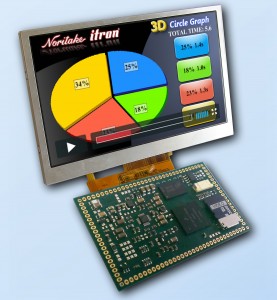
PumaNova module
Called PumaNova SOM, the firm’s TFT module has been designed for integration into systems designs such as PLCs, communications nodes and point of sales terminals.
According to Andy Stubbings, managing director of Itron UK, the intention was to design a touch display controller which would interface directly with a number of different TFT types.
The move from 8-bit parallel to serial interface for TFT displays created a data handling issue. “In most cases you cannot send data fast enough over serial,” said Stubbings.
The first PumaNova module, the PN28, is designed with a 454MHz ARM-based iMX287 processor, up to 512MByte of DDR2 memory, to run a Linux, Windows CE or Itron’s own iDEV OS, and it can handle all the display processing which simplifies the data carried over the serial interface to the display panel.
There is no need to offload processing to the host CPU.
Touch is an important capability and Itron has been able to use the company’s manufacturing processes used for VFDs to create multi-touch interfaces for TFTs. These are designed to work in extreme conditions and will work in the presence of water on the surface of the display.
Warnes claims the VFD process has performance and set-up benefits compared with indium tin oxide (ITO)-based projective capacitive touch panels.
This low impedance touch technology, which the firm calls MPC Touch, works with 4mm of plastic or 8mm of glass overlay and is able to support applications where users are wearing a range of gloves from nitrile, nylon, cotton and leather.
